
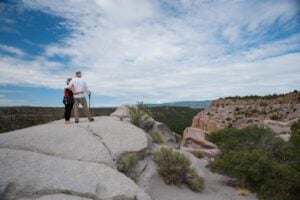
For decades, the default retirement plan for Americans leaving expensive states went something like this: sell the house, pack up, and head to Arizona, Florida, or the Carolinas. Those states built their entire retirement economies on volume, and it shows. Gated communities stacked side by side, HOA fees that rival mortgage payments, and summers so hot the pavement buckles.
New Mexico was never part of that conversation. And that, for the retirees now discovering it, is exactly the point.
Over the past two years, a quiet shift has taken shape along the I-25 corridor between Albuquerque and Santa Fe. ConsumerAffairs reported in 2026 that 21.3 percent of all inbound movers to New Mexico cited retirement as their primary reason for relocating.
The top feeder markets are Maricopa County (Phoenix), El Paso County (Texas), and Los Angeles County (California) – three places where housing costs, property taxes, or summer heat pushed people to look for something different. What they found was a state that checks nearly every box retirees care about and somehow still flies under the national radar.
New Mexico Retirement Taxes: The Numbers That Change the Math
Start with the money, because that is where most retirement decisions begin and end.
New Mexico does not tax Social Security income. For retirees whose monthly check is their primary income source, that single policy shifts thousands of dollars a year back into their pockets. Arizona does the same, but the comparison stops being favorable once you look at the full tax picture.
Retirees in New Mexico can also claim an $8,000 deduction on other taxable retirement income, including pensions, 401(k) withdrawals, and IRA distributions. Military retirees get an even stronger incentive: a $30,000 exemption on military retirement pay through 2026, which has made retiring in New Mexico especially appealing to veterans leaving service at Kirtland Air Force Base and other installations across the Southwest.
Property taxes add another layer. The effective property tax rate in Bernalillo County (Albuquerque) sits around 0.85 percent. Compare that to Maricopa County at 0.58 percent, which sounds lower until you factor in the difference in median home prices. A $310,000 home in Albuquerque generates a significantly smaller annual tax bill than a $430,000 home in the Phoenix suburbs, even at a marginally higher rate.
Cheapest Places to Live in New Mexico for Retirees
Housing costs are what turn a retirement plan from theoretical to real. In New Mexico, the median home price in Albuquerque sits around $310,000 – roughly half of what you would pay in Denver, two-thirds of Tucson’s climbing market, and a fraction of anything on the California coast.
But Albuquerque is not the only option. Several New Mexico cities offer retirees a lower cost of living without sacrificing access to healthcare, culture, or daily convenience:
- Albuquerque ($310,000 median home price): The largest city in the state. Two major hospital systems, an international airport, a growing food scene, and a cost of living index around 91 – nine percent below the national average. The Northeast Heights and Taylor Ranch neighborhoods remain popular with retirees for their safety, walkability, and access to the Sandia foothills.
- Rio Rancho ($295,000): Fifteen minutes northwest of Albuquerque: newer construction, lower crime rates, and strong community infrastructure. Intel’s $3.5 billion expansion keeps the local economy anchored.
- Las Cruces ($265,000): Southern New Mexico, close to El Paso’s airport and medical facilities. Warmer winters and an even lower cost of living than Albuquerque.
- Santa Fe ($615,000): The most expensive option, but retirees who can afford it get world-class art, walkable streets, cooler mountain temperatures, and a cultural depth that most retirement destinations cannot touch.
Why Retirees Are Choosing New Mexico Over Arizona
Arizona still pulls in large numbers. Recent migration data shows the state gained more than 2,500 retirement-age adults in net interstate moves in 2025 alone. But the conversation has changed.
New Mexico Magazine has spent much of 2025 and 2026 profiling couples who weighed Arizona against New Mexico and chose the Land of Enchantment specifically. One couple who relocated to Edgewood described wanting a place that feels authentic rather than manufactured – a sentiment that keeps surfacing in the profiles.
The practical differences back up the feeling:
- Summer heat: Albuquerque’s average July high is 93 degrees. Phoenix hits 106. Santa Fe stays around 85. For retirees with respiratory issues or heat sensitivity, the altitude difference alone is a deciding factor.
- Cultural identity: New Mexico’s blend of Native American, Spanish, and Anglo heritage gives its cities a character that master-planned retirement communities in Scottsdale or Mesa simply do not replicate.
- Outdoor access without extremes: The Sandia Mountains, the Rio Grande Bosque, and the high desert trails are all usable year-round. In Phoenix, outdoor activity shuts down for three to four months of summer.
Best Places to Retire in New Mexico: What Actually Matters
Lists of “best places to retire” tend to rank cities by cost alone. That misses half the decision. Healthcare access, airport proximity, walkability, and cultural engagement all weigh as heavily as housing prices for retirees who plan to stay active.
Retiring in Albuquerque consistently ranks highest on the practical checklist. Two Level I trauma centers (UNM Hospital and Presbyterian), a direct-flight airport (the Sunport), a public transit system that connects the key corridors, and a range of senior living options in Albuquerque that runs from independent communities to full assisted care. For retirees who want the resources of a mid-sized city without the sprawl and traffic of Phoenix or Denver, Albuquerque delivers.
Those who retire in Santa Fe tend to have different priorities – art, walkability, cooler weather, and a tighter community. The city lacks Albuquerque’s hospital depth but sits only 65 miles up I-25, making specialist appointments a reasonable day trip rather than a relocation barrier.
For those planning the actual move, trusted Albuquerque movers familiar with the senior relocation process handle everything from packing and furniture placement to coordinating with assisted living facilities on delivery timing and access requirements.
What Nobody Mentions Until You Get Here
Every retirement guide covers the tax breaks and the housing costs. Fewer mention the things retirees discover after they arrive.
The altitude adjustment is real. Albuquerque sits at 5,312 feet. Santa Fe is at 7,199. For retirees moving from sea-level cities, the first two weeks involve shorter breaths on stairs and drinking more water than you are used to. It passes, but it surprises people who did not expect it.
The dry air preserves your joints but punishes your skin. Moisturizer and chapstick become daily essentials, not occasional ones. Nosebleeds in the first month are common and harmless.
And the green chile question will find you on your first day. Red, green, or Christmas (both) – it appears on everything from breakfast burritos to cheeseburgers, and you will have an opinion within a week.
These are small adjustments, not dealbreakers. But knowing them before you arrive separates a smooth transition from an anxious first month.
The Window Is Still Open
New Mexico retirement has not hit the mainstream yet. No national “best places to retire” listicle has pushed it to the top the way Florida and Arizona were pushed in the 2010s. That means housing inventory is still available, a retirement gold rush hasn’t inflated prices, and the communities absorbing new retirees are doing so at a pace that doesn’t overwhelm local infrastructure.
That will not last forever. The tax incentives, the cost gap with neighboring states, and the quality of life are too strong to stay under the radar indefinitely. For retirees weighing their next chapter, 2026 is the year to look seriously at New Mexico before the rest of the country catches on.