
Finding an HRT clinic on Marco Island is easy; keeping one that checks meds, cancer risk, and side effects after 65 is harder—yet the Menopause Society says you don’t have to quit at 60 or 65 if benefits outweigh risks.
In 2026 the FDA removed the boxed warning from approved estrogen therapies, but that shift doesn’t endorse the compounded pellets many spas sell, which remain outside FDA oversight.
We scored six local providers on follow-up cadence, named clinicians, cost clarity, and adjustable routes. Unsure whether low energy is normal aging or a hormone gap? See our guide on how to tell normal aging from a treatable hormone deficiency.

Our public-information scorecard
We scored each clinic on a 100-point rubric built for real-world seniors. A factor counts only if the detail is publicly posted (no phone secrets, no guesswork).
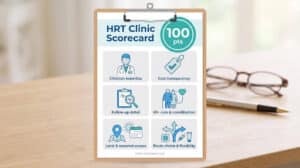
- Clinician authority and continuity – 30 points
- Published monitoring detail – 20 points
- Marco Island and seasonal access – 15 points
- Cost transparency – 15 points
- 65-plus care breadth and coordination – 15 points
- Route choice and reversibility – 5 points
Missing data earns zero, not a guess. We also skipped Google star ratings; research from SOCi shows these reviews often include a rating but no text, offering little insight into clinical safety.
These weights total 100 and determine the order of the six clinics that follow—no filler, no phantom providers.
At-a-glance comparison
We distilled each clinic’s public claims into a table so you can spot leaders on follow-up depth, on-island access, and cost clarity.
| Rank | Clinic | Best fit | Follow-up published? | Routes disclosed | Cost detail | Score |
| 1 | Contemporary Health Center | Physician depth plus crystal-clear pellet pricing | Lab review noted; cadence not stated | Pellets | Women $399–$425, men $750, labs extra, self-pay | 87 |
| 2 | RegenCen | Menopause focus right on Marco Island | Advanced labs, regular reviews | Topical, pellets | Not published | 76* |
| 3 | BodyLogicMD of Naples | Geriatrics-trained MD guides long-term care | Early check, then every 3–4 months | Multiple BHRT routes | Not published | 76* |
| 4 | Timeless | Physician-led choice of adjustable routes | Detailed men’s TRT pathway | Pellets, creams, injections, patches | Not published | 71 |
| 5 | Coastal Wellness | Flexible delivery with some telehealth | Labs, follow-up within weeks | Pellets, topicals, injections | Not published | 69 |
| 6 | A Better Solution Wellness | Straight-shooting on pellet and lab costs | Labs listed; visit cadence missing | Biote pellets | Women $425, men $700, labs $250/$150 | 62 |
*Tie broken in favor of on-island access.
A missing data point doesn’t sink a clinic; it simply scores zero for that metric. The Endocrine Society advises revisiting whether to continue hormone therapy at least annually, not merely repeating labs.
1. Contemporary Health Center: best overall for experience, breadth, and cost clarity

Contemporary Health Center Hormone Replacement Therapy Website Screenshot
Richard L. Bloy, MD, FACOG, brings more than 40 years of experience to this practice, and patient feedback often mentions thorough lab reviews and clear post-procedure instructions. A team of more than 15 professionals spans OB/GYN, anti-aging, BHRT, and functional medicine, and the practice treats both women and men. Its medical-spa side also offers weight-loss programs and aesthetic treatments, giving you one front door for hormone care plus related goals.
The Naples and Fort Myers offices serve Marco Island patients, with Naples the closer drive, and the clinic is one of the few on this list with clear pellet pricing: about $399–$425 for women and $750 for men per insertion, with labs extra and hormone services generally self-pay. You can also browse its broader Functional Medicine – Fort Myers & Naples services if you want hormones considered alongside weight loss and other health goals.
What’s still not published: how often follow-up visits occur, who calls if a lab flag appears, and whether adjustable routes (creams, patches) are available if a fixed-dose pellet feels too rigid. Bring those questions to your first consult.
2. RegenCen: best for on-island menopause-focused care

RegenCen Marco Island Menopause & Hormone Therapy Website Screenshot
Why it ranks here
RegenCen’s clinic at 815 Bald Eagle Dr. on Marco Island saves you the half-hour drive to Naples when you need a dose tweak or lab review. Its site lists Danielle Santos, PA-C, a Menopause Society Certified Practitioner, working under Gustav Lo, MD, who has more than 30 years of clinical experience.
That mix of formal menopause credentials and steady physician oversight lets the team address hot flashes, bone density, and shifting cardiovascular risk in one visit.
What’s still not published: full program cost, exact follow-up schedule, and whether FDA-approved routes are discussed before compounded options. Bring those questions to your first consult so your care plan and budget stay predictable.
3. BodyLogicMD of Naples: best for geriatrics-informed long-term follow-up
Why it ranks here
BodyLogicMD’s Naples office is led by Robert Rubin, MD, board-certified in internal medicine and geriatrics. When testosterone, estrogen, and chronic conditions share the same chart, a physician trained in polypharmacy, bone density, and cardiovascular risk can decide whether to tweak a dose or pause therapy as you age.
The network’s FAQ notes an early check-in a few weeks after starting therapy, followed by visits every three to four months to adjust prescriptions and address new concerns. That predictable cadence, plus nutrition and lifestyle coaching on the Naples page, makes hormone care one spoke of a broader healthy-aging plan.
What’s missing from the public site: full local pricing, whether labs are bundled or self-pay, and which services are available by telehealth versus in-clinic. Ask those questions up front so cost and access stay clear year-round.
4. Timeless: best for physician-led evaluation and route choice
Why it ranks here
Timeless lists Chaturani Ranasinghe, MD, a double board-certified anesthesiologist and interventional pain physician, as lead clinician. Her hormone pages offer more than pellets: creams, injections, patches, and implants, so you are not locked into one fixed dose.
The men’s TRT guide spells out a proper work-up. Morning total and free testosterone are confirmed on repeat testing, along with LH, FSH, estradiol, PSA, and a CBC/hematocrit. Dose titration then follows with periodic labs and direct-physician visits. This diagnostic detail is rare in local marketing copy and signals genuine oversight.
What’s still not published: women’s specific follow-up cadence, full program cost, and which services occur on Marco Island versus Naples. Ask those questions if your travel or budget is tight.
5. Coastal Wellness: flexible delivery with some telehealth

Coastal Wellness Naples and Marco Island Telehealth HRT Website Screenshot
If you split time between Marco Island and another state, Coastal Wellness can bridge seasons with a mix of in-clinic and video visits. The site notes that labs are drawn and reviewed within weeks after therapy begins, and that care can use pellets, topicals, or injections to match comfort and health changes.
What’s missing: full program cost, the cadence of routine labs after the initial period, and whether telehealth can handle prescription changes when you are out of state. Ask these points early so access and budget stay predictable.
6. A Better Solution Wellness: best for on-island pellet price transparency

A Better Solution Wellness Marco Island Pellet Pricing Website Screenshot
If you want a straight answer on cost before a syringe comes out, A Better Solution delivers. Its Marco Island page lists women’s pellets at $425 (every three to four months), men’s pellets at $700 (every five to six months), plus labs: $250 baseline and $150 follow-up. Few clinics publish numbers that specific.
The practice leans on the Biote pellet model, so convenience is the perk: one short visit, an implant in the hip, and nothing to fuss with for months. The trade-off? Once the dose is in, you cannot dial it back until the pellet wears off. The site mentions pre-insertion labs and a recheck but stays silent on who reviews results, how annual benefit-risk talks happen, or what the plan is for sudden bleeding or a blood-pressure spike.
Before you book, confirm four essentials:
- The full name and Florida license of the prescribing clinician.
- The exact visit schedule for interpreting labs and adjusting future doses.
- Whether creams or patches are on standby if a pellet proves too strong.
- The backup plan if you need care while visiting family out of state.
Price clarity earns A Better Solution a spot on this list; make sure that transparency also covers follow-up and safety logistics.
Frequently asked questions

Does Medicare cover BHRT labs?
Sometimes. Medicare pays individual laboratory tests under the Clinical Laboratory Fee Schedule, not a blanket “BHRT panel.” Coverage depends on the specific CPT code, the medical reason on the order, and whether the lab is in network. According to the Centers for Medicare & Medicaid Services (CMS), confirm coverage with your Part B or Advantage plan before blood is drawn.
Can home health replace my hormone clinic?
No. A home-health nurse can check vitals, review pillboxes, and flag side effects, but only the prescribing clinician can change doses or refill pellets. Think of home health as extra eyes, not the captain. Keep both teams talking; our guide to senior in-home care options explains how.
What should snowbirds confirm about telehealth follow-up?
- Where you may legally sit during a video visit.
- Who orders labs in your summer state and how results reach Florida.
- Refill and urgent-care rules while you are away.
- Whether the same clinician keeps responsibility year-round. Get it in writing to avoid airport-gate surprises.
What should a caregiver bring to a follow-up?
A current medication-and-supplement list; date, route, and dose of the last pellet, injection, or prescription change; recent labs or imaging; and a brief diary of wins, stumbles, or side effects. A dated snapshot lets the clinician adjust therapy with confidence.
Conclusion
Staying on hormone therapy after 65 can be a reasonable choice, but only if someone is still watching closely. The Menopause Society says there is no automatic cutoff at 60 or 65 when benefits outweigh risks, and the Endocrine Society advises revisiting the decision at least once a year. That means a real benefit-risk conversation with a clinician who knows your medications and history, not just another lab draw.
None of the six clinics above publishes everything a 65-plus patient needs to know. Use the scorecard to narrow your list by what matters most to you: physician experience, an on-island office, a published follow-up schedule, or clear pricing. Then take the gaps to your first consult:
- Who orders and reviews my labs, and who calls me if a result is flagged?
- How often will I be seen after the first few months?
- If a pellet feels too strong, can I switch to a cream or patch?
- Who handles refills and urgent questions when I am out of state?
- What is self-pay, and which lab tests might my Part B or Advantage plan cover?
Bring a caregiver and a current medication list, and get the answers in writing. Monitoring is what keeps treatment a help, not a hazard.