
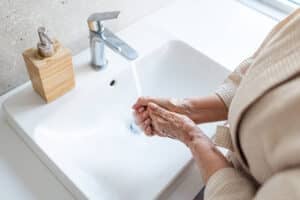
Hot water looks the same to anyone turning the tap. The skin that meets it does not. After seventy, the outer layer has thinned, the fat beneath it has shrunk, and the nerves that register heat answer a little slower. One splash that would make a thirty-year-old swear and jump back can send someone in their eighties to a burn unit instead.
The number that controls that gap is small, physical, and often forgotten. It is the dial on the water heater – usually set once at the factory and left alone for twenty years. For older adults, where that dial sits can decide whether a surprise at the sink stays a surprise.
Why Hot Water Hurts Older Skin Faster
Aging skin loses collagen and water. The epidermis flattens. The dermis thins. The fatty cushion under both shrinks. Heat passes through a thinner barrier and reaches deeper layers sooner than at forty.
Reflexes slow with age too. The pull-away reaction takes a fraction longer, and arthritis, stroke recovery, or holding a cane in the other hand can slow it further. Diabetes with peripheral neuropathy removes the warning signal altogether. A foot soaked in overly hot water may feel pleasantly warm until the damage is already done.
Severe scalds also heal badly after seventy. Weaker circulation, slower immune response, and reduced cell turnover push recovery into weeks. Some cases end in skin-graft surgery.
The Five Degrees That Change Everything
The U.S. Consumer Product Safety Commission has published the same plain table for decades. At 150°F, water from a tap can give an adult a third-degree burn in about two seconds. At 140°F it takes six seconds. At 130°F, around thirty. At 120°F, roughly five minutes.
Those numbers are why the Commission and the American Burn Association put the ceiling for household hot water at 120°F, about 49°C. A splash below that line still startles. Above it, time runs out before an older adult can move away.
Most families never check. Many heaters ship set higher. A past service call about lukewarm showers may have ended with the dial nudged up again. One measurement with a cooking thermometer settles the question.
Checking the Temperature at Home
The test is quick and uses nothing special.
- Run the hot tap of the sink farthest from the heater for a full two minutes.
- Fill a cup and read it with a kitchen or candy thermometer.
- Repeat at a second fixture to confirm.
- If the reading is above 120°F, turn the dial down, wait a few hours, retest.
- Note the date on the heater or on a card inside the utility closet.
A tank older than ten years, or one that will not hold a stable setting, is usually worth replacing rather than nursing through another repair.
Why a Plumber Belongs in This Conversation
Turning a dial is simple. Keeping the whole system both safe and free of legionella is less so. Water held below 120°F inside the tank itself can grow bacteria, which is why many plumbers keep the tank at 140°F and install a thermostatic mixing valve on the outlet. The valve blends hot and cold down to about 115–120°F before the water reaches any tap. The household gets the storage temperature that keeps the tank clean and the tap temperature that keeps older skin safe.
That installation is one of the small, high-value jobs local plumbers handle most weeks. On the Sunshine Coast of British Columbia, where retirees make up a large share of the population, listings for Plumbers in Sunshine Coast, BC show the companies covering water heaters, mixing valves, and other anti-scald fittings. The regional directory gathers area firms with reviews and contact details, which saves families some of the asking-around when they need someone familiar with aging-in-place work. One visit can also add a pressure-balancing valve in the shower, which stops the sudden hot spike when a toilet flushes in another room.
Small Fixtures That Help the Whole Bathroom
Once the heater and the mixing valve are sorted, a few bathroom details lower risk further. Single-lever faucets are easier to steer than two-handle sets, especially for arthritic hands that may push too far toward hot. Anti-scald tub spouts cap flow temperature at the fixture itself. A hand-held shower on a flexible hose lets a caregiver aim water away from a seated bather. None of these parts costs much. All can go in during the same visit as the mixing valve.
A grab bar near the tap finishes the picture. The point is not gadgets. The point is shortening the distance between an unexpected hot splash and a confident step back.
One Setting That Keeps Older Adults in Their Own Homes
A water heater at or below 120°F at the tap, backed by a mixing valve and a lever handle, prevents the type of burn that keeps older adults out of their own homes for months. The CPSC and the American Burn Association have pointed at that number for forty years. The hardware to meet it is standard stock on any plumbing truck. The family’s share of the work is small and finite – measure once, call a plumber once, write the date on the heater. That short list is the quiet work that keeps the bathroom from becoming the room an older person has learned to fear.