
Most college students don’t think about senior care until it affects someone in their own family. A grandparent’s fall. A parent’s sudden role as caregiver. That moment tends to arrive without warning, and by then there is a lot to learn in very little time.
Campus awareness projects change that equation. They introduce students to the realities of elder care years before the personal urgency hits, and they create connections between generations that benefit both sides. The Council of Independent Colleges and the AARP Foundation have already brought more than 40 colleges into intergenerational service programs, reaching nearly 2,000 older adults in a single academic year. The model works. The question for most students is where to start.
Campus Presentations and Awareness Workshops
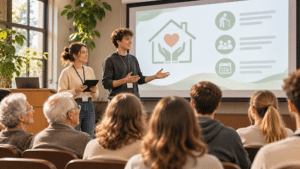
A well-organized campus talk on dementia, fall prevention, or caregiver burnout can shift how an entire student body thinks about older adults. The format is flexible. A 20-minute talk during a club meeting works just as well as a full workshop with Q&A and printed handouts.
The challenge for most students is the visual side. A presentation on Alzheimer’s statistics needs clean, readable slides that communicate data without overwhelming the audience. Infographics, timelines, and comparison charts carry more weight than paragraphs of text on a screen. Students who need polished decks for a faculty review or a grant pitch can turn to PowerPoint writing services to get the design and structure right while they focus on the research. That split makes sense when the presentation doubles as a graded assignment or a funding proposal where visual quality affects the outcome. The content itself should come from credible sources. The Alzheimer’s Association, the CDC’s elder care data, and local Area Agencies on Aging all publish free statistics and fact sheets that students can adapt for their campus audience.
Volunteer Programs at Care Facilities
Direct contact with residents of assisted living and nursing homes remains the most effective way to build empathy and practical knowledge. Several universities have built structured volunteer programs around this idea.
At Concordia University Wisconsin, a team of 29 students from five health disciplines assessed older clients enrolled in Meals on Wheels. They screened for fall risks, medication issues, and mental health concerns. One home visit uncovered 87 medication bottles, some of them decades old. That single finding justified the entire project.
Spelman College in Atlanta took a different approach. Their SIS Oral History Project records the life stories of African American women over 70, with some participants as old as 107. Students participate in shared activities — worship, meals, dance — and capture narratives that would otherwise be lost.
Neither program requires medical training to start. A phone call to a local care facility and a faculty sponsor are enough to get a pilot volunteer schedule on the calendar.
Digital Literacy for Older Adults
Isolation is one of the biggest health risks for people over 65. Video calls, messaging apps, and online banking reduce that isolation, but many older adults never learned to use them.
A campus digital literacy project pairs students with seniors for one-on-one tech tutorials. The sessions cover practical tasks:
- Video calls with family members on a tablet or smartphone
- Online grocery orders and pharmacy refills
- Identifying scam emails and suspicious links
- Setting up and managing a simple password system
Each session runs about 45 minutes. Students report that patience matters more than technical skill. The older adults often know what they want to do — they just need someone to walk them through the steps without rushing.
Fundraising and Community Events
Reserve a table in the student union for a day. Print fact sheets on caregiver burnout, fall prevention, and local senior services. Invite a representative from a nearby assisted living facility to answer questions. These events cost almost nothing and reach hundreds of students between classes.
Charity Drives with a Specific Goal
Generic “donate to the elderly” drives underperform. Targeted campaigns work better. Collect specific items that care facilities actually need: large-print puzzle books, non-slip socks, moisturizing lotion, or prepaid phone cards for residents without family plans. Contact the facility first and ask what they run out of most often.
Benefit Events with Student Talent
Open mic nights, bake sales, and trivia tournaments can raise funds for local hospice programs or adult day care centers. Partner with a student organization that already draws a crowd, and split the planning work between both groups.
How These Projects Build Real Skills
The academic benefits go beyond extra credit. Students who participate in elderly care awareness projects develop skills that stand out on a resume and in graduate school interviews.
| Skill | How the project builds it |
| Public communication | Presenting complex health topics to non-expert audiences |
| Project management | Coordinating volunteers, schedules, and facility contacts |
| Research and data analysis | Gathering and presenting statistics for proposals and reports |
| Empathy and active listening | Working directly with residents and their families |
| Grant writing | Preparing funding requests for campus or external sponsors |
According to a report from Dominican University of California, over half of incoming occupational therapy students originally wanted to work with children. After intergenerational projects, 75% of graduates chose to work with older adults instead. Exposure changes career trajectories.
Conclusion
Elderly care awareness projects give college students something no textbook can deliver — direct contact with the challenges and rewards of caring for an older generation. The projects range from a single campus table to a multi-semester research program. What they share is the ability to change how students see the decades ahead, both for the people they serve and for themselves. The best time to understand senior care is before you need it. A campus project is the easiest first step.