
The Plan at a Glance
- Fire safety guidance asks every household to get out in under two minutes, know two ways out of every room, and practice at least twice a year, and those goals need adjusting when someone can’t use the stairs.
- Older adults face a higher risk of dying in a home fire, with adults 85 and older at 3.4 times the risk of the general population in 2023.
- Moving the bedroom to the ground floor is the simplest change, and when that isn’t possible, the plan needs a helper, a route, and equipment for the stairs.
- Telling neighbors and building staff about the plan ahead of time can save minutes that matter during an emergency.
Most families make a fire escape plan around one assumption, which is that everyone in the home can walk out quickly. When a parent or spouse uses a walker or wheelchair, or simply can’t manage stairs safely anymore, that assumption breaks, and the household needs a plan built around how that person will actually get out of the home.
For many older adults who live in a two-story house, a townhome or an upper-floor condo, the stairs are the hardest part of that plan. A track-based emergency stair chair belongs in the same category as smoke alarms and fire extinguishers, as life-safety equipment, and multi-story retirement and senior communities should build these chairs into their building safety infrastructure. Stored at the top of a staircase, a chair like this can provide immediate access to safety for someone who can’t walk down. Evacuscape, a Canadian-owned manufacturer that serves the eldercare and multi-family residential sectors across Canada and the U.S., designs its chairs so that one staff member or caregiver can bring a person weighing up to 180 kg (400 lbs) down the stairs without lifting them. That gives people with reduced mobility a safe and predictable way out. It’s one piece of a larger plan, and the rest of that plan matters just as much.
Why Older Adults Need Their Own Escape Plan
The numbers make a strong case for planning ahead. The US Fire Administration’s data on older adult fire deaths shows that in 2023, adults 65 and older were 2.5 times more likely to die in a fire than the general population. Those 85 and older were 3.4 times more likely. Slower reaction times, hearing loss that makes alarms harder to notice, and limited mobility all reduce the time a person has to get out.
That risk affects a large and growing group of people. The 2020 Census counted 55.8 million Americans aged 65 and over, or about 1 in 6 people in the country. Many of them live in homes with upstairs bedrooms that they bought decades earlier, when stairs were no obstacle at all.
Start with the Basics Every Household Needs
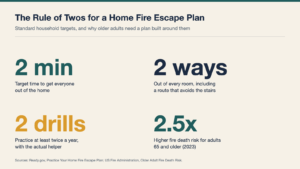
Standard fire safety advice is the foundation, and it applies to every home. Ready.gov’s guidance on home fire escape plans recommends making a written plan, learning two ways out of every room, practicing getting out in under two minutes, and holding a home fire drill at least twice a year.
For someone with limited mobility, each of those goals needs a practical adjustment. Two ways out of a bedroom might mean a door to the hallway and a window that opens onto a porch roof, which is only useful if the person can actually use that second route. Getting out in under two minutes may require a helper, so the drill should include that helper and should be timed honestly.
Adapting the Plan for Someone Who Can’t Use the Stairs
Small changes inside the home often make the biggest difference, and the right equipment matters as much in a retirement community as it does in a family house. The steps below cover the most common situations families face.
Staffing Realities and Duty of Care in Senior Housing Egress
In retirement homes and senior apartment buildings, the type of evacuation device on site decides how many staff an evacuation needs. The National Fire Protection Association’s evacuation planning guide for people with disabilities notes that carry-type devices require two or more operators, which creates a real risk of muscle strain, drops and coordination failures on a night or weekend shift when few staff are on duty. Track-type chairs reduce that risk, because continuous rubber traction tracks absorb and regulate the resident’s weight on the way down while one person controls the descent. Some track chairs, including Evacuscape’s models, also work as flat-surface transit chairs, which lets a single assistant wheel an older resident through long hallways and smoke doors without a dangerous transfer partway through the escape.
Move the Bedroom Downstairs if You Can
The US Fire Administration’s fire safety tips for people with disabilities advise sleeping on the first floor in a multi-story home and, if possible, living near an exit. Converting a den or dining room into a bedroom removes the stairs from the escape route entirely, and it often makes daily life easier too.
Plan for the Stairs When Moving Isn’t an Option
Some homes have no space for a ground-floor bedroom, and some older adults live in condos where every room is on an upper floor. In those cases, the plan should name who will help, which staircase they’ll use, and what equipment they’ll use to bring the person down safely. Evacuation chairs designed for home use fold flat for storage and let one trained person guide a seated adult down the stairs, which is safer for both people than attempting a carry.
Make Sure Alarms Can Wake Everyone
Smoke alarms only help if they’re heard. If hearing loss is a concern, alarms with strobe lights or bed-shaker devices can alert a sleeping person, and interconnected alarms make sure a fire in the basement sounds an alarm in the upstairs bedroom.
Tell Your Neighbors and Building Staff
Ready.gov’s guidance for people with disabilities suggests talking with neighbors who can assist if you need to evacuate. In a condo building, let the property manager know that a resident may need help on the stairs, so that the information reaches whoever coordinates the building’s emergency response.
When to Leave and When to Shelter in Place
Firefighters are trained to rescue people, but waiting in a burning home is risky because smoke spreads quickly and response times vary. If a safe route down the stairs exists and someone can help, getting out early is usually the better choice. If smoke or fire blocks the stairs, the person should stay in a room with the door closed, seal the gaps if possible, call 911 and signal from a window so responders know exactly where they are.
Using an Evacuation Chair Safely at Home
Home models are built for the same controlled stair descent as the chairs used in hospitals, offices and residential buildings, and the key to using one safely is practice. The family member or caregiver who will operate it should train with it before an emergency, ideally using the manufacturer’s training materials. Store it at the top of the stairs where it can be reached quickly, and check it during every home fire drill.
Running a Drill That Reflects Real Life
Practice the plan at least twice a year with the actual helper on the actual route, and time it from the moment the alarm sounds. If it takes longer than two minutes, look at what slowed you down, whether that was getting the person out of bed, reaching the equipment or managing the stairs, and adjust the plan before the next drill.
Planning for a Parent Who Lives Alone
Living alone with stairs is one of the hardest situations to plan for, because there may be no one in the home to help during a fire. The safest step is usually moving the bedroom to the ground floor. Beyond that, consider a monitored alarm system that contacts emergency services automatically, talk with nearby neighbors about checking in, and make sure the local fire department knows that a person with limited mobility lives at the address.
Questions to Ask a Condo or Apartment Building
Many condo and apartment buildings have general fire procedures, but they don’t always include specific plans for residents who can’t use the stairs. Ask the property manager what the building’s procedure is, whether staff or floor wardens are trained to assist residents, and whether any evacuation equipment is kept on site. If the answers are unclear, a personal plan with your own helper and equipment fills the gap until the building’s procedure improves.

Start the Conversation This Week
A fire escape plan for someone who can’t manage the stairs starts with one honest conversation, a walk through the house and a timed practice run. Sit down with your parent or spouse, agree on the bedroom and the helper, and try the route together before the seasons change. The plan you rehearse together is the one that holds up when the alarm sounds.